We carry out a variety of concrete actions to achieve its ecological restoration and sustainable development goals in Madagascar.
Dynamic Agroforestry
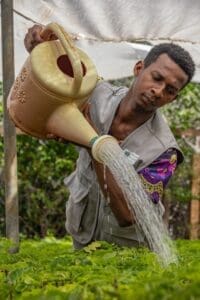
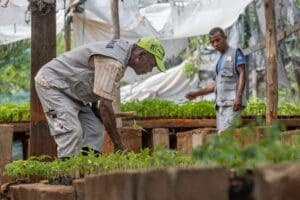
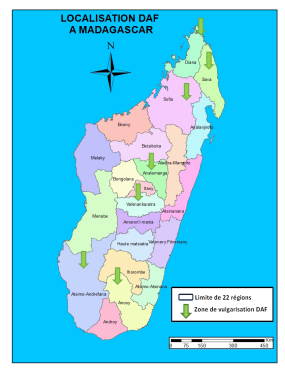
We popularize dynamic agroforestry practices in Madagascar to restore ecological functions and reduce the pressures caused by destructive agricultural practices that harm terrestrial ecosystems. We aim to disseminate dynamic agroforestry techniques across various regions of the island to improve the living conditions of local communities and reduce threats to biodiversity. Currently, more than 800 households across Madagascar practice dynamic agroforestry thanks to the interventions of the Tsimoka Association. This technique enables communities to diversify their production and increase their income by $20 to $55 a month.
Forest Restoration
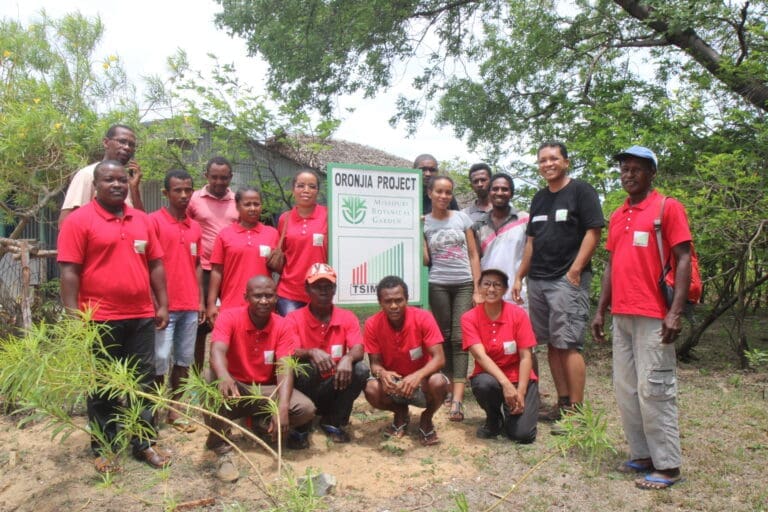
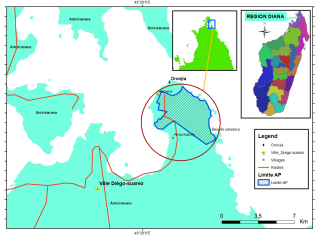
We restore dry forests in Madagascar so that local communities can benefit from the ecosystem services we provide. In 2015, the Oronjia Protected Area was officially established, thanks to the support of Missouri Botanical Garden (MBG).
The Oronjia Protected Area serves as an experimental ground for assessing the effectiveness of various restoration techniques, soil conservation, and biodiversity enhancement. The local Tsimoka team monitors the ecological changes taking place and evaluates their impact on the ecosystem. Through indigenous tree planting techniques, we have successfully restored about twenty hectares of forest in Oronjia.
Dynamic agroforestry practices outside the Oronjia Protected Area are applied in a controlled setting, requiring close collaboration with local communities. This approach aims to integrate indigenous or exotic trees to improve continuous productivity, especially by restoring essential ecological functions such as water regulation. It relies on a well-defined plan that reflects plantation diversification, their density, and agricultural succession (progressive and continuous agricultural production).
Awareness and Training
We continue experiments and innovations in the NAP Oronjia to improve ecological restoration techniques. Our goal is to share dry forest restoration techniques in Madagascar’s Protected Areas to improve the state of biodiversity and ecosystem services for local communities.
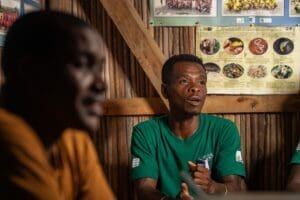
We also provide training on dynamic agroforestry to communities and farmers, updating the protocols and methods used and appropriate.
Lastly, we accompany and monitor the beneficiaries to achieve better results by updating the community monitoring protocols (through data collection and verification of the application of techniques), developing a monitoring plan, and providing advice and recommendations to the beneficiaries.
Ecological Monitoring
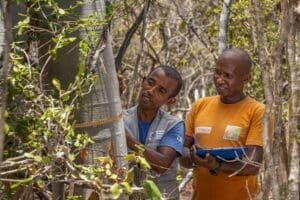
We establish a robust monitoring and evaluation system to communicate the results of ecological restoration efforts. This system enables us to regularly assess the progress of restoration activities, gather essential data on biodiversity, ecosystem health, and the effectiveness of our interventions.
We have managed to maintain and even strengthen the successes of our interventions since our creation: - All identified threats to the area have been significantly reduced over the years. A prime example of this success is the dramatic decrease in the number of charcoal kilns within the protected area. In 2012, there were 52 active kilns operating, contributing to deforestation and environmental degradation. However, through dedicated conservation efforts and community engagement, this number has been reduced to zero by 2022. - Forest restoration is also progressing. This regeneration can be demonstrated by the total basal area of tree trunks per hectare, which, in a series of replicated plots, has increased from 16.1 m2 in 2012 to an average of 18.32 m2 over the past four years, indicating a balanced and healthy forest stand.
Our success story
The success of dynamic agroforestry is one of the cornerstones of the creation of our association.
- A family living on the outskirts of the Oronjia Protected Area experienced a profound transformation in their livelihood. In 1995, water was scarce, and the surrounding population had to travel 3 km to collect water. - As of 2014, when this family began practicing dynamic agroforestry, a series of positive changes occurred, such as the availability of agricultural products and improved soil fertility. - In 2019, access to water was restored, enabling the development of rice paddies and wells once more. - This family has also taken up fish farming.
Oronjia Protected Area location map
Location map of Tsimoka’s dynamic agroforestry intervention regions
Join us in creating a sustainable future for Madagascar